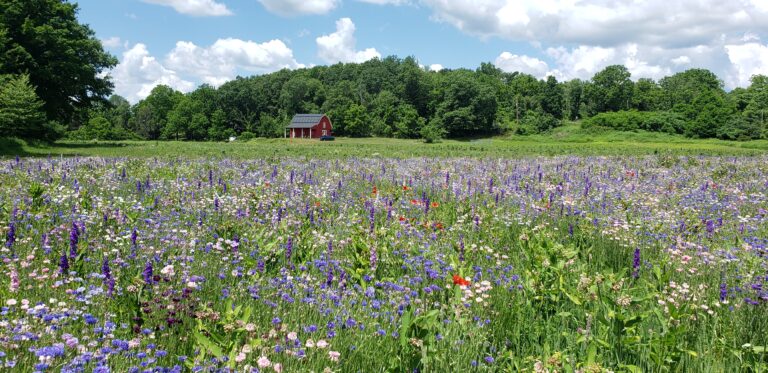
Choosing between annual and perennial native plants can shape the success of your entire project. Whether you are establishing a pollinator habitat, stabilizing soil, or designing a long-term landscape, the right mix of plant types will influence how quickly your site establishes and how well it performs over time.
In this guide, you will learn:
- The core differences between annual and perennial native plants
- When to use each based on your project goals
- Why combining both often leads to better results
- How to choose the right mix for your planting goals
Let’s start by breaking down the key differences between annual and perennial native plants.
What’s the Difference Between Annual and Perennial Native Plants?
Annual native plants complete their entire life cycle in a single growing season, while perennial natives persist for multiple years and return each season from established root systems. Understanding this distinction helps you choose the right plants for your immediate and long-term goals.
At a biological level, most annuals germinate, grow, flower, set seed, and die within one year. Perennials, by contrast, invest heavily in root development during early growth stages, then re-emerge year after year from the same root system. This difference shapes everything from establishment speed to maintenance requirements.
Key Differences at a Glance
| Lifespan | Root Structure | Establishment Speed | Ecological Role | |
| Annuals | One growing season | Shallow, fast-developing roots | Rapid germination and early bloom | Early succession, quick pollinator support |
| Perennials | Multiple years, often decades | Deep, persistent root systems that improve soil structure | Slower establishment, stronger long-term presence | Long-term habitat stability and soil health |
In practice, this means you should think of annuals as short-term performers and perennials as long-term investments. A seed mix composed mostly of perennial species has the potential to last more than a decade if properly maintained. Many successful native plantings use both perennial and annual plants to balance immediate impact with lasting ecological value.
When Should You Use Annual Native Plants?
Annual native plants are best when you need fast results. They establish quickly, provide early-season blooms, and help stabilize soil while longer-lived species take hold.
Because annuals complete their life cycle in one season, they germinate rapidly and begin flowering sooner than most perennials. This makes them especially useful when you are working with disturbed soils or tight project timelines. In many cases, they act as a functional bridge, delivering immediate ecological value while slower-growing perennials develop below the surface.
Best Use Cases for Annual Native Plants
- Rapid site stabilization: Use annuals to reduce erosion on newly disturbed or exposed soils
- Nurse crops in seed mixes: Provide early cover and suppress weeds while perennials establish
- Early pollinator support: Offer quick access to nectar and pollen during the first growing season
- Short-term visual impact: Deliver fast color in restoration sites, roadsides, or managed landscapes
Annuals require reseeding to persist over time. Their role is immediate, not permanent, which is why they are most effective when used strategically alongside perennials. A common example is Annual Ryegrass (Lolium multiflorum). Ryegrass works because it germinates quickly and provides immediate ground cover to protect soil from erosion. After one growing season, the ryegrass dies out and leaves behind valuable organic material that further enriches the soil.)*. Ryegrass works because it germinates quickly and provides immediate ground cover to protect soil from erosion. After one growing season, the ryegrass dies out and leaves behind valuable organic material that further enriches the soil.
*Note: If you choose to plant Ryegrass alongside native species, we recommend not exceeding an application rate of 12 lbs/acre. Higher rates may smother native species.
When Are Perennial Native Plants the Better Choice?
Perennial native plants are the better choice when you are planning for long-term stability, soil health, and consistent habitat value. While they take longer to establish, they deliver lasting ecological benefits that annuals cannot match.
Why Choose Perennials for Long-Term Projects
- Soil improvement: Deep roots help build organic matter and stabilize soil over time
- Water management: Improved infiltration reduces runoff and supports drought tolerance
- Consistent wildlife habitat: Provide dependable nectar, pollen, and structure, cover, and protection year after year
- Lower long-term maintenance: Reduce the need for reseeding once established
Species like Purple Coneflower (Echinacea purpurea), Butterfly Milkweed (Asclepias tuberosa), and Little Bluestem (Schizachyrium scoparium) are widely used in native plantings for their durability and ecological value.
You should expect a slower start with perennials, but that patience pays off. Over time, they form the backbone of resilient, self-sustaining landscapes.
Can You Combine Annual and Perennial Native Plants? (Best Practice)
Yes. In most cases, combining annual and perennial native plants is the most effective approach. This strategy gives you immediate results while building a stable, long-term plant community.
In native seedings, annuals are often used as “nurse crops.” They establish quickly, providing early ground cover and pollinator resources, while perennials develop more slowly beneath them.
Why This Combination Works
The key lies in the balance between short and long-term objectives.
Annuals will flower early, suppress weeds, and avoid the “bare ground” phase common in perennial-only plantings. Mixed plant life cycles and successive bloom periods also support a wider range of pollinators and wildlife. Over time, the perennials take over as the dominant, long-lived species.
How to Implement a Mixed Planting of Native Annual and Perennial Plants
Successful mixed planting begins with the right seed mix and site preparation:
- Prepare your site thoroughly: Remove existing vegetation and create good seed-to-soil contact
- Use a balanced seed mix: Include both annual and perennial native species suited to your region, staggering bloom periods
- Plan for establishment phases: Expect strong annual growth in year one, with perennials increasing in years two and three
Think of annuals as your short-term support system and perennials as your long-term investment. When used together, they create more resilient and successful plantings.
How Do You Choose the Right Mix for Your Project?
The right mix of annual and perennial native plants depends on your timeline, site conditions, and long-term goals. There is no one-size-fits-all solution. You need to align your plant selection with how the site will be used and how quickly you need results.
Start by defining your priorities. If you need rapid coverage or erosion control lean more heavily on annuals. If your goal is long-term habitat or low-maintenance landscaping, prioritize perennials. Most projects benefit from a combination of both.
Key Factors to Consider
- Project timeline: Do you need results in the first growing season, or can you wait for perennials to establish?
- Site conditions: Soil type, moisture levels, and sun exposure all influence which species will succeed
- Maintenance capacity: Annuals may require reseeding, while perennials reduce long-term input
- Ecological goals: Wildlife and pollinator support, erosion control, and biodiversity may require different species mixes
You should also consider using regionally adapted seed mixes rather than selecting species individually. This helps improve establishment success and ensures your planting performs as intended.
Building the Right Native Plant Strategy for Long-Term Success
The choice between annual vs. perennial native plants is not necessarily about picking one over the other. More often, it’s about using each strategically. Annuals give you speed, early coverage, and immediate ecological value. Perennials provide long-term stability, deeper soil benefits, and consistent habitat over time.
When you combine both, you create a planting that performs in year one and continues to improve for years to come.
As you plan your project, focus on your timeline, site conditions, and ecological goals. From there, selecting the right mix becomes much more straightforward.
If you are looking for regionally adapted seed mixes or individual native species, Ernst Conservation Seeds offers a wide selection designed to support successful establishment and long-term performance.
Quick Summary
Annual and perennial native plants serve different but complementary roles in successful landscapes. Annuals provide fast establishment and early ecological benefits, while perennials deliver long-term stability and soil health. The most effective approach is often a strategic combination of both, tailored to your site conditions and project goals.
Annual vs. Perennial Native Plants FAQ
Both are valuable. Annuals provide quick, early-season resources, while perennials offer consistent, long-term habitat.
Yes. Once established following the first growing season, perennials typically require less reseeding and ongoing input than annuals.
Yes. Combining them is a best practice that supports faster establishment and long-term ecologically productive landscapes.